

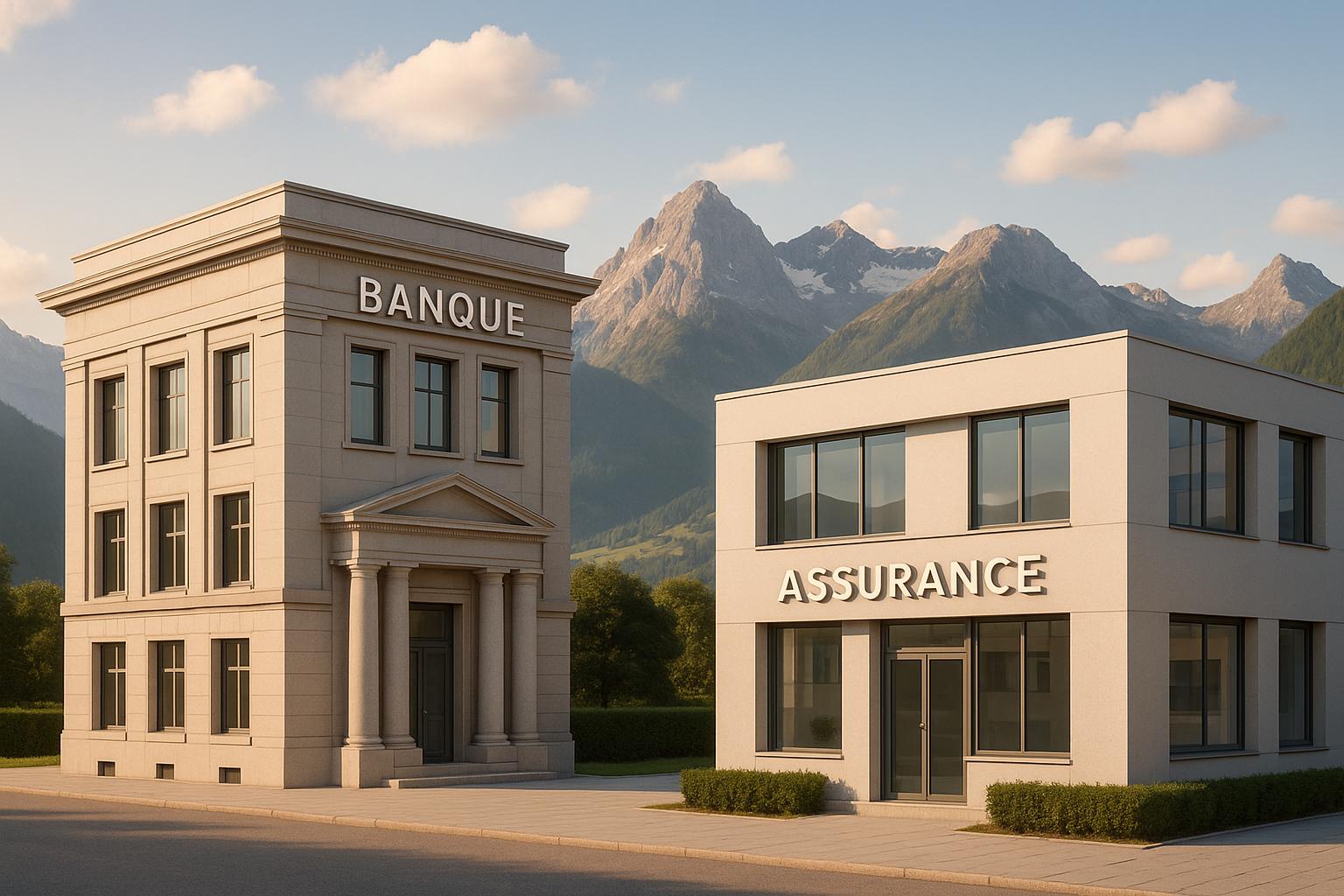
In Switzerland, the 3rd pillar is a private savings solution that complements theAVS and the pension fund. You can choose between two main options for your 3rd pillar: The banks or The insurances. This choice depends on your priorities, such as flexibility, security or returns.
Key points to remember:
-
Banks :
- Offer great flexibility in payments.
- Savings or investment solutions (funds, ETFs).
- Generally lower fees (0.5% to 1.5%).
- No death or disability coverage.
- Exposure to market fluctuations for investments.
-
Insurances :
- Combine savings and protection (death, disability).
- Possible capital guarantees.
- Fixed, less flexible premiums.
- Higher fees (1.5% to 3%).
- Medical questionnaire required.
Quick comparison:
In summary :
- Choose one bank for freedom and higher potential returns.
- Opt for a insurance if you are looking for security and built-in protection.
Your choice depends on your goals: flexibility for young workers or security for families and people close to retirement.
Do your 3rd pillar: in Banking or Insurance?
Banking solutions for the 3rd pillar
Banking solutions for the 3rd pillar stand out for their simplicity and flexibility. Unlike insurance products, they are based on the principle of direct savings, without integrating an insurance component. This approach is particularly suitable for those who want to maintain total control over their retirement savings.
How does the 3rd banking pillar work
The 3rd banking pillar is based on two main types of products: 3a savings accounts and investment solutions in securities.
- Les 3a savings accounts offer a fixed interest rate, generally between 0.25% and 1.5%, thus guaranteeing the capital. These accounts also allow immediate availability of funds in liquid form.
- Les securities investment solutions allow you to invest in investment funds, of ETF or even obligations. These investments offer an average annual return estimated between 3% and 6%, depending on the composition of the portfolio.
Payment management is flexible: you can choose to make monthly, quarterly, or one-off deposits. The minimum amount required varies between banks, but is generally around CHF 100 by installment.
Benefits of banking solutions
Banking solutions offer several advantages that deserve to be highlighted.
- Flexibility : You can pause, resume, or adjust your payments at any time, with no penalties. This freedom is particularly useful for cross-border commuters or people whose incomes vary.
- Full control : You decide on your investment strategy, adjust your investments and follow the evolution of your capital in real time thanks to banks' online platforms.
- Transferability : If you want to change banks, your 3a capital can be transferred free of charge, unlike insurance contracts, which often impose repurchase penalties.
- Transparent fees : The annual management fees for bank investment solutions are generally between 0.5% and 1.5%. There are no hidden fees or payout commissions, making it easy to compare different offers.
Disadvantages of banking solutions
Despite their numerous advantages, these solutions also have some limitations.
- Lack of insurance coverage : Unlike insurance products, banking solutions do not provide for additional capital in the event of death or disability. In the event of death, the accumulated savings will simply be transmitted to the beneficiaries, according to the legal rules in force.
- Investment risks : Security-based solutions are exposed to market fluctuations. For example, the financial crises of 2008 and 2020 showed that portfolios invested in equities could lose between 20% and 30% of their value over a short period of time. While returns generally recover over the long term, these changes may be of concern to some investors.
- Autonomous management : You are responsible for all investment decisions. This includes monitoring the markets and adjusting your strategy according to your goals. This management can be complex for people with little experience or lack of time.
These limits are in contrast to insurance products, which offer additional guarantees and different options, as discussed in the next section.
Insurance solutions for the 3rd pillar
Insurance solutions linked to the 3rd pillar combine retirement savings and protection, offering a financial safety net while insuring your loved ones. Unlike traditional banking products, these contracts include an insurance dimension that can be valuable at critical times.
How does the 3rd pillar of insurance work
The 3rd pillar of insurance is based on a contract that combines savings and risk coverage. You pay fixed premiums, divided between building up your retirement capital and financing insurance guarantees.
Savings can be managed in two main ways:
- Capital guarantee : Some contracts provide a guaranteed minimum return, to which may be added profit shares.
- Investment funds : Other contracts allow you to invest in funds, offering the possibility of higher returns, but without capital guarantees.
The insurance component covers major risks such as death and incapacity for work. In the event of death, your beneficiaries receive a capital determined by the contract. In the event of disability, the insurer can take care of the remaining premiums and pay out annuities to maintain your savings.
The opening of such a contract generally requires a medical questionnaire. Depending on your health condition and the amount insured, additional examinations may be requested. The premiums are then calculated according to several criteria: age, health condition and selected benefits. These elements define the contours of an offer that combines security and savings.
Benefits of insurance solutions
Insurance solutions for the 3rd pillar offer several important benefits:
- Built-in protection : In the event of premature death, your loved ones receive guaranteed capital, useful to cover family expenses or debts. In the event of disability, insurance takes over to ensure the continuity of retirement savings.
- Regular and disciplined savings : Fixed premiums encourage systematic savings, allowing retirement capital to be built up gradually and rigorously.
- Long-term financial security : Swiss insurance companies, which are subject to strict regulations and have guarantee funds, offer a reliable framework, especially with guaranteed capital contracts.
- Tax benefits : Like banking solutions, these contracts make it possible to deduct the premiums paid from taxes and benefit from advantageous taxation when the capital is withdrawn.
Disadvantages of insurance solutions
Despite their advantages, these solutions also have some limitations:
- Rigidity of contracts : Long-term commitments can be binding. A suspension or reduction of payments often results in penalties and may affect guarantees.
- High fees and penalties : Management fees and redemption penalties reduce the overall return on savings. Early termination, especially in the early years, can lead to a significant loss of the amounts invested.
- Complexity of products : The multiple terms and conditions, as well as the variability of profit shares, make it sometimes difficult to compare offers.
- Restricted access : The medical questionnaire may limit access to these products. People with health problems or older subscribers may face restrictions or additional premiums.
Banking vs Insurance: Direct Comparison
Main differences between banking and insurance
The banking and insurance offers for the 3rd pillar stand out on several points, including flexibility, investment options, fees and guarantees included.
These distinctions allow you to choose a solution adapted to your needs. Banks offer greater freedom in payments and higher opportunities for returns, although with more risks. For their part, insurances incorporate protection guarantees and capital that is often secured, but impose more rigid conditions.
How to choose according to your needs
To select the solution that is right for you, it is essential to assess your priorities and your personal situation.
Opt for a banking solution if you prefer flexibility and potentially higher returns. This option is ideal for people with variable incomes, such as the self-employed, or those who want to adjust their payments according to their professional situation. If you are comfortable with financial markets and accept some volatility, banking solutions offer interesting diversification for your investments.
Young professionals in particular appreciate this flexibility. It allows them to adapt their savings to their career or to projects such as buying real estate. In addition, transfers between banks are simple, an asset if you are likely to move.
Look for an insurance solution if safety is your priority. These contracts are particularly suitable for families or those with dependants. In the event of death, the coverage included can be used to pay off a mortgage or to secure the financial future of children.
Individuals close to retirement (around 45 to 55 years of age) often find insurance capital guarantees attractive. At this stage of life, maintaining capital becomes more important than seeking high returns.
Finally, your risk tolerance plays a key role in this choice. If you are worried about the idea of market fluctuations and you prefer to have a clear vision of your retirement, insurance is a reassuring option. On the other hand, if you are ready to accept some uncertainty in order to aim for higher returns, banking solutions are more appropriate.
To help you make this choice, Best Third Pillar offers free simulations. These personalized analyses take into account your income, family situation and retirement goals in order to determine the most relevant solution for you.
Sbb-ITB-505FA4B
Conclusion: Finding the right 3rd pillar solution
Key points to remember
Comparing banking and insurance solutions highlights an essential point: your choice should reflect your personal priorities and financial situation. A banking solution offers more flexibility and can generate higher returns, while an insurance solution guarantees the security of your capital while protecting your loved ones. Young working people and the self-employed often turn to banking solutions, while families and people close to retirement prefer insurance. In summary, the key is to match your choice to your financial goals.
If you need support in making this important decision, we are here to help.
Get help with Best Third Pillar
Navigating through the many offers available in Switzerland can be a real challenge. That's where it comes in Best Third Pillar, with its independent expertise and its tools designed to support you.
As an independent consulting firm, Best Third Pillar is distinguished by its neutrality. With partnerships established with more than 60 banks and insurance companies in 2025, the company gives you access to a wide range of options, allowing you to benefit from the best offers available. This independence ensures that the recommendations made are only in your best interests.
Thanks to free simulations, Best Third Pillar Assess your financial profile, family situation and retirement goals to develop an appropriate strategy. In addition to this analysis, personalized follow-up is offered to answer your questions and adjust your plan over time. This service is completely free, without commitment and completely independent.
To optimize your retirement savings while reducing your taxes, contact Best Third Pillar starting today. A personalized consultation will allow you to choose the solution that will best meet your needs and secure your financial future.
FAQs
What are the tax advantages of a 3rd pillar with a bank or insurance company in Switzerland?
Banking and insurance solutions for the 3rd pillar in Switzerland
The solutions offered under the 3rd pillar in Switzerland, whether banking or in the form of insurance contracts, offer attractive tax advantages. In fact, the annual contributions you pay can be deducted from your taxable income, thus directly reducing your tax burden. For the year 2025, the maximum deductible amount is CHF 7,258 for employees affiliated to a pension fund.
When you withdraw accumulated capital, it is taxed separately at a prime rate, often less than that applied to your regular income. This allows you to maximize your savings while limiting your taxes. These tax benefits apply to bank accounts as well as to insurance products, although specific details may vary depending on the provider and the type of product selected.
How do I choose between a banking solution and an insurance solution for the 3rd pillar according to my risk tolerance?
Bank or insurance for the 3rd pillar: how to choose?
To decide between a banking solution and an insurance solution for your 3rd pillar, it is important to think about your risk tolerance, to your financial goals and to your need for flexibility.
The solutions Of insurance offer benefits such as coverage in the event of death or disability, providing additional security. But they often come with higher costs and limited flexibility. On the other hand, the solutions Banks are generally more flexible. They allow you to invest in products like ETFs, which can offer more attractive returns, although they do not include insurance coverage.
If your priority is security and stability, an insurance solution could meet your expectations. Conversely, if you aim for a long term growth and want to manage your funds independently, a banking solution will undoubtedly be more appropriate. Also consider your personal situation, for example if you are a cross-border worker or a foreign resident, to choose the option that best suits your needs.
What elements should I analyze to choose between a banking or insurance solution for my 3rd pillar in Switzerland?
Bank or insurance for the 3rd pillar: how to choose?
Making the right choice between a banking or insurance solution for your 3rd pillar requires taking into account several important aspects:
- Safety and guarantees : Insurance products often include protection in the event of death or disability, as well as a guarantee on invested capital. This can be interesting if you want to offer greater financial security to your loved ones or to protect yourself against the unexpected.
- Flexibility : Banking solutions, on the other hand, stand out for their flexibility. They generally allow you to choose your investments and offer the possibility of withdrawing your funds before maturity. However, this freedom comes with greater exposure to financial market fluctuations.
- Duration and personal goals : Insurance contracts often impose fixed terms and rigid conditions. On the other hand, a banking solution may be better suited if you are looking for a freer and more flexible approach.
Your decision will depend on several factors: your appetite for risk, your priorities between safety and performance, as well as your personal and professional situation. Take the time to assess your long-term goals to identify the option that best fits your needs.